I have a ton of things to blog about and I'll do as many as I can over the next week or so.
Sunday, July 7, 2013
Back Again
We've had internet problems here, but they are now resolved. The COG has figured out a way to keep his blog up using his ipad software. I couldn't get my software to even load.

Sunday, April 28, 2013
It is Surpassingly, Beautifully Spring today. At Last.
i thank You God for most this amazing
by e. e. cummings
i thank You God for most this amazing
day:for the leaping greenly spirits of trees
and a blue true dream of sky; and for everything
which is natural which is infinite which is yes
(i who have died am alive again today,
and this is the sun's birthday; this is the birth
day of life and of love and wings: and of the gay
great happening illimitably earth)
how should tasting touching hearing seeing
breathing any--lifted from the no
of all nothing--human merely being
doubt unimaginable You?
(now the ears of my ears awake and
now the eyes of my eyes are opened)
day:for the leaping greenly spirits of trees
and a blue true dream of sky; and for everything
which is natural which is infinite which is yes
(i who have died am alive again today,
and this is the sun's birthday; this is the birth
day of life and of love and wings: and of the gay
great happening illimitably earth)
how should tasting touching hearing seeing
breathing any--lifted from the no
of all nothing--human merely being
doubt unimaginable You?
(now the ears of my ears awake and
now the eyes of my eyes are opened)
Sunday, April 21, 2013
New York Times Haikus
The New York Times has a haiku generator. It scans the newspaper and finds haiku of the kind you were taught to write in grade school - 5 syllables, 7 syllables, 5 syllables. Many of them aren't that great, but the best ones of the day are selected by human journalists and printed in a tumblr blog.
If you like, Click here,
you'll be whooshed like magic to
The Times Haiku Blog
If you like, Click here,
you'll be whooshed like magic to
The Times Haiku Blog
Saturday, April 13, 2013
Great Cartoon
I just had to post this cartoon, which others who spend too much time on the internet will appreciate.
It's from this site

It's from this site
Sunday, April 7, 2013
Church of St. Trophime in St. Paul?
How on earth did the chapel of St. Kate's college in St. Paul come to have a copy of the Church of St. Trophime? I googled, pausing for a just moment to give thanks on this Sunday morning, for the amazing miracle that is the internet.
St. Kate's was founded in 1905 by the Sisters of St. Joseph of Carondelet, who, although French, were not from Arles. After the end of WWI, the president of the college, Mother Antonia McHugh- a nun from North Dakota - decided that the college needed a chapel that was large, Romanesque and based on the beautiful cathedrals of France. This was at a time when the college only had 3 buildings and 300 students, so she was dreaming big.
She travelled to Europe in 1922 and, although there is no record on her official itinerary of a trip to Arles, she must at least have heard of it and may have visited it. The church is famous for its beautiful Tympanum (the carved, arched porch) even though it is no longer a cathedral. It's even mentioned as an example of beauty in Pound's Canto XLV. Apparently the architect also visited St. Trophime, as well as other churches in France and Spain.
Among the many differences between the two churches is the absence of some of the most obvious Catholic symbols - the religious paintings and large crucifix -at St.Kates. It's a college chapel, after all, so it's important that students of all religions will feel comfortable there. Also, the carvings of the saints and the stories featured in the stained glass are of female saints mostly. Others allude to people who were involved in the creation of the chapel (A statue of St. Anthony is for Mother Antonia, a statue of St. Augustine for the Bishop of St. Paul, Austin Dowling etc.).
The chapel, Our Lady of Victory, was completed in two years, and dedicated on an unseasonably warm day in October, 1924. According to answers@yahoo.com the fastest construction of a cathedral in the middle ages was 25 years. The longest was 600 years. So, yes, two years from Mother Antonia's trip to the completion of the building.
The AIA guide to the Twin Cities says that although the front of the chapel is a pretty direct copy from St. Trophime, the rest of the church draws on influences from all over - the bell tower is Italianate, the brick pattern of the interior, modern, the Batchelder Arts and Crafts tiles are from California and have a Moorish feel. But everyone seems to agree that despite being a patchwork of styles and influences, the finished product is beautiful.
For most of this information, I relied heavily on an article in the St. Catherine's magazine by John Spayde. Click Here to see the whole article.
Also, for the Heathens among you, a Cathedral is the church attached to a bishopric. The word 'cathedral' comes from the Greek word for 'chair' (kathedra). Originally, the Cathedral was where the Bishop's seat was. Literally, there was a seat - a chair or throne which the bishop sat in to pontificate. I looked up that word to see if only popes could properly pontificate, but, no, bishops do it too. Arles had a bishopric from the second century or so - St.Trophime being the first bishop - but in 1801, the bishop moved his chair from Arles to Aix, where it now resides. Did you notice that I had the good taste to not make jokes about the word bishopric? Though, obviously, not enough good taste to not think them or to eschew mentioning them.
St. Kate's was founded in 1905 by the Sisters of St. Joseph of Carondelet, who, although French, were not from Arles. After the end of WWI, the president of the college, Mother Antonia McHugh- a nun from North Dakota - decided that the college needed a chapel that was large, Romanesque and based on the beautiful cathedrals of France. This was at a time when the college only had 3 buildings and 300 students, so she was dreaming big.
She travelled to Europe in 1922 and, although there is no record on her official itinerary of a trip to Arles, she must at least have heard of it and may have visited it. The church is famous for its beautiful Tympanum (the carved, arched porch) even though it is no longer a cathedral. It's even mentioned as an example of beauty in Pound's Canto XLV. Apparently the architect also visited St. Trophime, as well as other churches in France and Spain.
Among the many differences between the two churches is the absence of some of the most obvious Catholic symbols - the religious paintings and large crucifix -at St.Kates. It's a college chapel, after all, so it's important that students of all religions will feel comfortable there. Also, the carvings of the saints and the stories featured in the stained glass are of female saints mostly. Others allude to people who were involved in the creation of the chapel (A statue of St. Anthony is for Mother Antonia, a statue of St. Augustine for the Bishop of St. Paul, Austin Dowling etc.).
The chapel, Our Lady of Victory, was completed in two years, and dedicated on an unseasonably warm day in October, 1924. According to answers@yahoo.com the fastest construction of a cathedral in the middle ages was 25 years. The longest was 600 years. So, yes, two years from Mother Antonia's trip to the completion of the building.
The AIA guide to the Twin Cities says that although the front of the chapel is a pretty direct copy from St. Trophime, the rest of the church draws on influences from all over - the bell tower is Italianate, the brick pattern of the interior, modern, the Batchelder Arts and Crafts tiles are from California and have a Moorish feel. But everyone seems to agree that despite being a patchwork of styles and influences, the finished product is beautiful.
For most of this information, I relied heavily on an article in the St. Catherine's magazine by John Spayde. Click Here to see the whole article.
Also, for the Heathens among you, a Cathedral is the church attached to a bishopric. The word 'cathedral' comes from the Greek word for 'chair' (kathedra). Originally, the Cathedral was where the Bishop's seat was. Literally, there was a seat - a chair or throne which the bishop sat in to pontificate. I looked up that word to see if only popes could properly pontificate, but, no, bishops do it too. Arles had a bishopric from the second century or so - St.Trophime being the first bishop - but in 1801, the bishop moved his chair from Arles to Aix, where it now resides. Did you notice that I had the good taste to not make jokes about the word bishopric? Though, obviously, not enough good taste to not think them or to eschew mentioning them.
Friday, April 5, 2013
Roman Cities - a rumination which might be pretty boring but it's my blog. You can skip if you want.
Arles felt very familiar to me, and I quickly figured out the layout. It reminded me of Toulouse and I thought a lot about that. I think it's because they were Roman cities and had similar layouts that dated way back to the Romans. Of course, Toulouse no longer has the big Roman structures it once had, but the pattern of the town is similar. The Town Square - Le Capitole - dominated by the Hôtel de Ville - is a remnant in spirit, at least, of the Roman Forum, as in Arles. In both places here are big straight wide streets leading through the town- many of them now pedestrianized, and with small warrens of medieval streets filling in between them. These bigger streets are pretty much where they were in Roman times, leading to and from the gates of the town in the cardinal directions. Both places have a major river running through them, with the older part of town on one side of the river. And then seeing the necropolis - I'd never seen them, only read about them - followed by the cemetery and realizing how similar they are really, made me think again of the Romans. (Also the Monty Python sketch - what did the Romans ever do for us)(but that's beside the point).
Sister Rose says a Classics professor she once had said that the best time to be alive in the world was to be in Roman France in the 2 or 3 century. It was peaceful, prosperous, and full of activity. The French really took to Roman occupation. When the Roman Empire died out, France continued growing in the same directions the Roman's had started. Many of the things we think of as typically French came from the Romans - wine and cheese and olive oil and maybe cemeteries and town plans. And, in the South of France, at least, there is a sense that the spirit of Roman life somehow survives.
Britain was different. The Britons had never really adopted the Roman way of life. Britons continued to fight throughout the Roman occupation. When the Romans withdrew quite abruptly at the end of the 4th century, leaving chaos and tribal warfare behind them, the 'Spirit of Rome' did not linger. While Britain once had amphitheatres and theatres and beautiful Roman villas and baths and necropoli etc., basically only Hadrian's wall survives intact. The stones were 'quarried' for other uses. There are still some Roman roads that are part of the highway system. There are some place names - Leicester, London, Colchester etc. - the bottoms of some fortified walls, like the ones at Pevensey Castle (iirc). And in Bath, at least some part of the baths are or were Roman. But not like France.
After the Romans, until the Norman conquest, Britain was basically a series of tribal wars. That 600 years is pretty interesting and contributed more to the present life of Britain than, I think, the Romans did. But that's a discussion for another day.
Sister Rose says a Classics professor she once had said that the best time to be alive in the world was to be in Roman France in the 2 or 3 century. It was peaceful, prosperous, and full of activity. The French really took to Roman occupation. When the Roman Empire died out, France continued growing in the same directions the Roman's had started. Many of the things we think of as typically French came from the Romans - wine and cheese and olive oil and maybe cemeteries and town plans. And, in the South of France, at least, there is a sense that the spirit of Roman life somehow survives.
Britain was different. The Britons had never really adopted the Roman way of life. Britons continued to fight throughout the Roman occupation. When the Romans withdrew quite abruptly at the end of the 4th century, leaving chaos and tribal warfare behind them, the 'Spirit of Rome' did not linger. While Britain once had amphitheatres and theatres and beautiful Roman villas and baths and necropoli etc., basically only Hadrian's wall survives intact. The stones were 'quarried' for other uses. There are still some Roman roads that are part of the highway system. There are some place names - Leicester, London, Colchester etc. - the bottoms of some fortified walls, like the ones at Pevensey Castle (iirc). And in Bath, at least some part of the baths are or were Roman. But not like France.
After the Romans, until the Norman conquest, Britain was basically a series of tribal wars. That 600 years is pretty interesting and contributed more to the present life of Britain than, I think, the Romans did. But that's a discussion for another day.
Modern Necropoli - French Cemeteries
Because it was a beautiful day, we walked from Les Alyscamps along the old city wall. We encountered this typical French cemetery. I'm showing it because of its similarity to Les Alyscamps, especially during the days when the sarcophagi were piled 3 high.
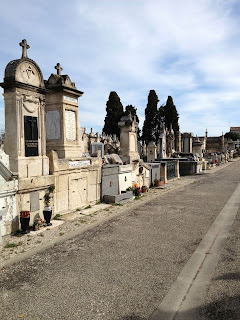

Necropolis, of course, means 'city of the dead'. I think you get that 'city' feeling in this kind of cemetery. We wandered for a while, looking at the tombstones and the floral displays that families had left. It's kind of a comforting place really.
In New Orleans some years ago, we were told the cemeteries were built above ground because the water table was so high. But I've seen cemeteries like this all over the French Caribbean as well as France, so I wonder if it wasn't just tradition after all. And if that tradition dates back to the Romans, at least.
Subscribe to:
Posts (Atom)
